


An Environmentally-Friendly Refrigerant
An air conditioner gives us a comfortable and cooling environment. However, you probably do not clean it as often as you do for other household surfaces. An air conditioner circulates and filters air, removing dust, pollutants, and mold. Thus, if left uncleaned, it is prone to accumulation of dust, growth of mold and development of other contaminants, which can affect the air quality it delivers, and its cooling performance.
Panasonic leverages its unique proprietary nanoe™ X technology together with Inside Cleaning function to cleanse the inside of an indoor unit, minimizing microbial growth to deliver clean air during cooling or heating operation.






What is R32 Refrigerant?
In air conditioning systems, a refrigerant is a chemical compound used to absorb heat and create cool air through the compressor and evaporator. There are many types of refrigerant used in air conditioning systems. One of it is the R32 refrigerant, which has low environmental impact yet maintains its efficiency in transferring heat.
Characteristic of R32 Refrigerant


Comparison of R32 and Other Refrigerant Types
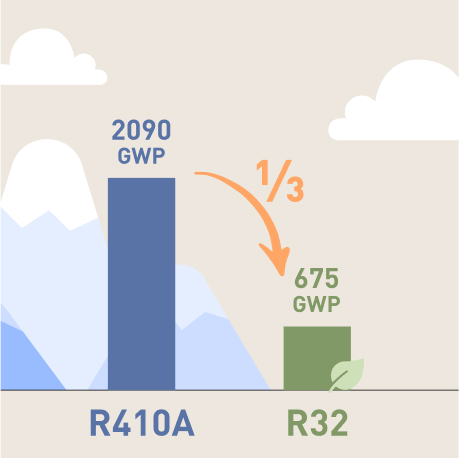
R32 has been introduced as an alternative to R410A for its lower GWP compared to R410A. R410A is the replacement for the phased out R22 refrigerant.
Refrigerant Properties of R32, R410A and R22
| R32 | R410A | R-22 | |
|---|---|---|---|
| Deodorises | Single Component | 2 Components | Single Component |
Chemical Formula | CH2F2 | CH2F2 / CHF2CF3 | CHCLF2 |
Ozone Depletion Potential (ODP) | 0 | 0 | 0.055 |
Global Warming Potential (GWP) | 675 | 2090 | 1810 |
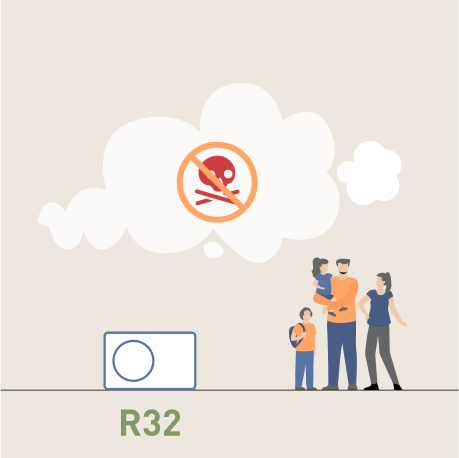
Toxicity | None | None | None |
Flammability | A2L Mildly flammable | A1 Non-flammable | A1 Non-flammable |
What are the Benefits of Using R32?
There are many benefits of switching to R32 refrigerant for your air conditioning system, which includes the following:

Higher Cooling Capacity
R32 has high latent heat, which means more heat is absorbed. Its excellent heat transfer capabilities make it more efficient in cooling.

Reduce Energy Cost
R32 is less dense than R410A and requires a smaller quantity to operate. This makes it more energy-efficient than other refrigerants to help you lower energy bills. Additionally, single component R32 is easy to reuse, recycle and is easy to recharge on site; keeping the cost low.

Environmentally Friendly
Compared to R410A, R32 has low global warming potential, minimizing its effects on climate change. Additionally, R32 is pure hydrofluorocarbon with zero impact on ozone layer, making it a significantly less harmful option for the environment.
