

What Are Avoided CO2 Emissions?
A New Metric for Measuring Corporate Contributions to Greenhouse Gas Emissions Reduction Across Society

In January 2026, the International Electrotechnical Commission (IEC) standardized avoided CO2 emissions, establishing a new framework for measuring how companies contribute to reducing greenhouse gas (GHG) emissions across society. As the ability to address decarbonization becomes an increasingly important factor in corporate competitiveness, companies are being evaluated on how effectively they reduce GHG emissions through their business activities. Until recently, however, there was no widely accepted metric for measuring and recognizing the impact of products and services that help customers and society reduce emissions. At the same time, there is growing recognition worldwide that reducing a company's own emissions alone will not be enough to achieve decarbonization. Against this backdrop, avoided CO2 emissions are attracting increasing attention as a new measure of corporate environmental impact.

What Are Avoided CO2 Emissions?
A metric for quantifying a company's contribution to reducing GHG emissions across society
Avoided CO2 emissions quantify the reduction in society-wide GHG emissions achieved through the provision and adoption of lower-carbon products and services compared with conventional alternatives.
Scope 1, 2, and 3 emissions, as defined by the globally recognized GHG Protocol, measure emissions generated across a company's operations and value chain, providing a measure of its efforts to reduce its own environmental impact. By contrast, avoided CO2 emissions capture the positive impact of a company's products and services by quantifying their contribution, or potential contribution, to reducing GHG emissions across society.
Because avoided CO2 emissions are closely linked to corporate value creation and the prevention of future social and economic losses associated with climate change, the metric is attracting growing interest from investors and financial institutions.

Why Are Avoided CO2 Emissions Needed Now?
Creating a more direct link between business activities and a decarbonized society
Until recently, there was no established metric for evaluating the positive impact of lower-carbon products and services, even as their growing adoption made an increasingly significant contribution to reducing GHG emissions across society. Corporate environmental performance was therefore assessed primarily based on reductions in emissions generated through a company's own business activities.
Because avoided CO2 emissions increase as products and services that support decarbonization become more widely adopted, the metric makes it possible to assess contributions to decarbonization alongside business growth. It also helps resolve an apparent dilemma: a company's Scope 1, 2, and 3 emissions may increase as it expands the production and supply of products and services that enable emissions reductions elsewhere in society. Avoided CO2 emissions reveal the broader environmental benefits delivered by those products and services.
While many GHG accounting frameworks have been developed through international initiatives, international standardization of avoided CO2 emissions has progressed through discussions involving Japanese companies, including Panasonic Holdings. Financial institutions are also exploring the use of the metric as a reference point for corporate assessments and investment decisions.
Under the new IEC standard, the emissions reductions attributable to a product are assessed against those of the most widely adopted alternative or prevailing market practice. This approach helps prevent overstated environmental claims, including greenwashing, while improving transparency through standardized calculation methods.
Establishing avoided CO2 emissions as a means of recognizing companies that contribute to society-wide decarbonization could help direct more capital toward such companies. This, in turn, could accelerate the adoption of lower-carbon products and services, supporting both a faster transition to a decarbonized society and sustainable economic growth.
How Are Avoided CO2 Emissions Calculated?
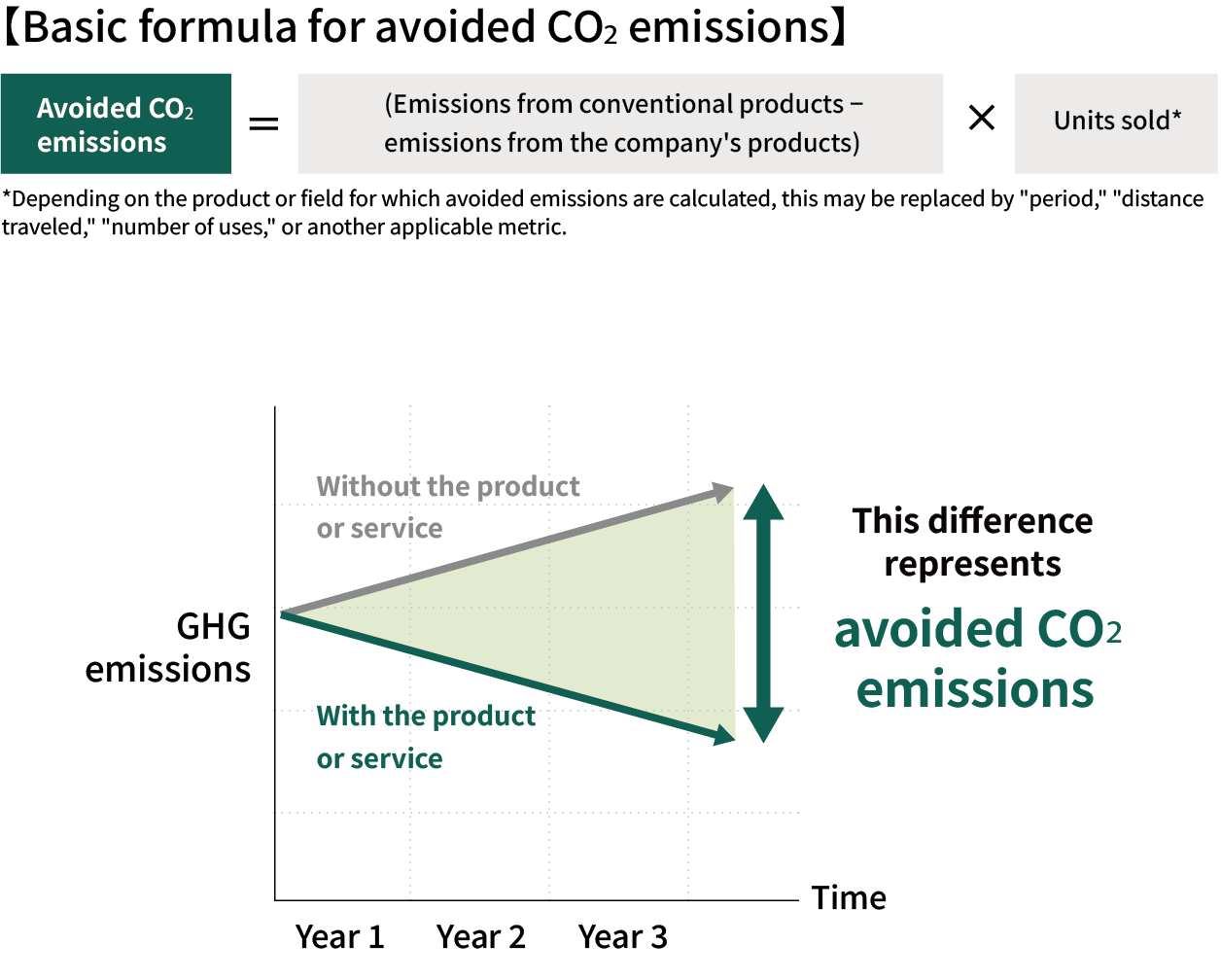
Difference in emissions compared with conventional alternatives × sales volume
In simple terms, avoided CO2 emissions are calculated as follows. First, a baseline is established by identifying the product, service, or technology that would most likely have been adopted in the market if the company's product or service were not available. The GHG emissions associated with that baseline product, service, or technology are then calculated over its entire life cycle. Next, the life cycle GHG emissions associated with the company's lower-emission product or service are estimated. The difference between the two figures represents the avoided CO2 emissions attributable to the product or service. A company's total avoided CO2 emissions are calculated by multiplying the avoided emissions per product or service by the relevant sales volume and aggregating the results across its portfolio. Companies may disclose both the avoided CO2 emissions generated by individual products and services and the total across their portfolios.
*Actual calculation methods vary by product category and other factors.
Panasonic Energy's Contribution to the Environment Through Its Products
Technological innovation as the source of avoided CO2 emissions
Panasonic Energy's battery business is a major source of avoided CO2 emissions. Technological advances that increase energy density and extend battery life enable the company's batteries to help reduce GHG emissions across society when used in applications such as electric vehicles (EVs) and data centers. Compared with conventional alternatives, these advanced batteries can deliver significant reductions in emissions over their entire life cycle. In this way, technological innovations create avoided CO2 emissions.
Guided by its Mission, "Powering a society where shared well-being and environmental sustainability thrive together," Panasonic Energy has made decarbonization a key management priority as it seeks to drive positive change across society. To expand the environmental benefits generated through the use of its products and solutions, the company has set a target of achieving 45 million tons of avoided CO2 emissions by fiscal 2031.
Achieving this target will depend on the broader adoption of products and solutions that support decarbonization, including those that enable the electrification of mobility. Panasonic Energy seeks to maximize GHG emissions reductions across the product life cycle by expanding the adoption of solutions such as EVs and electrically-assisted bikes, reducing emissions from its own manufacturing operations through the use of renewable energy and improved factory efficiency, and expanding recycling initiatives.
Since fiscal 2025, Panasonic Energy has also quantified the avoided CO2 emissions generated by its distributed storage battery systems for data centers, which help reduce emissions by replacing conventional alternatives. Panasonic Energy recorded 20.19 million tons of avoided CO2 emissions in fiscal 2026. The company aims to more than double this figure to 45 million tons by fiscal 2031.

Let us look at how avoided CO2 emissions are generated, using Panasonic Energy's cylindrical lithium-ion batteries for automotive use as an example.
When a battery electric vehicle (BEV) powered by Panasonic Energy rechargeable batteries and an internal combustion engine (ICE) vehicle travel the same distance, the BEV uses energy more efficiently because a greater share of that energy is converted into motion. The difference between the CO2 emissions associated with the ICE vehicle's fuel consumption and those associated with charging and operating the BEV represents the emissions avoided through the use of the BEV. This difference is counted as avoided CO2 emissions.

Relationship Between the Inflation Reduction Act and Avoided CO2 Emissions
The Inflation Reduction Act (IRA) is U.S. legislation designed to address climate change by reducing CO2 emissions by 21 billion tons between 2023 and 2050 and avoiding $5.6 trillion in global economic losses associated with climate change. The law provides tax credits and subsidies for industries that contribute to energy security and climate action. Panasonic Energy benefits from a tax credit of $35/kWh for automotive batteries produced in North America. We believe this value reflects Panasonic Energy's efforts to promote the spread of EVs in society and contribute to avoided CO2 emissions through the manufacture of automotive batteries. As evidence of this relationship, the amount of our tax credit under the IRA is proportional to the amount of avoided CO2 emissions from our automotive batteries. We believe this is an example of how our contribution to decarbonization through automotive batteries has been recognized by society in financial terms.
Toward Shared Well-Being and Environmental Sustainability
Building awareness to accelerate the transition to a decarbonized society
In addition to its Mission, "Powering a society where shared well-being and environmental sustainability thrive together," Panasonic Energy is guided by its Vision, "Be the energy that shapes the future," and its Will, "As humanity, we push beyond," as it works to achieve that mission.
Electricity becomes more sustainable when energy storage is added to the traditional stages of generation, transmission, and consumption. By enabling electricity to be stored and used when and where it is needed, batteries create value that is essential to the decarbonization of society. We aim to make the batteries we manufacture widely available and create positive change in society through our products and solutions.
Avoided CO2 emissions offer a new yardstick for recognizing and evaluating the environmental value created by companies. The metric is expected to become increasingly integrated into practical decision-making, including product procurement, financing, and investment. As measurement becomes more closely linked to evaluation, avoided CO2 emissions could be adopted across a wide range of industries and develop into a global benchmark for competitiveness.
The first step is to build broader awareness of this new metric. Greater understanding can encourage the adoption of lower-carbon products and services and enable more companies to pursue decarbonization and business growth simultaneously. Through continued advances in battery technology and the products and solutions those advances make possible, Panasonic Energy remains committed to reducing GHG emissions across society.

2026-10-26


