


Policy
Our Mission is “Powering a society where shared well-being and environmental sustainability thrive together.” and therefore, responding to climate change, an urgent issue common to all humankind, is our most important challenge. To address this challenge, we will work to increase avoided CO2 emissions (when our products and solutions are used by end-users) and reduce CO2 emissions during battery production, including procurement of raw materials, production, and product distribution. By increasing our environmental contribution and reducing our environmental impact, we are working together as a Group and in collaboration with our stakeholders to maximize the value we provide.
Increasing avoided CO2 emissions
Contribution to the environment through our products
Panasonic Energy is working to increase avoided CO2 emissions through mobility electrification and other initiatives to contribute to the environment through the spread of our products and solutions.
To increase avoided CO2 emissions, we have been working to quantify the avoided CO2 emissions of our Li-ion batteries for automotive, Electrically-assisted bikes and other products that can reduce CO2 emissions through product electrification, as well as products that can be expected to reduce CO2 emissions through the energy-saving benefits of replacing conventional products, including our storage battery systems for data centers*1. This brings our avoided CO2 emissions to approximately 19.69 million tons in fiscal 2026.
By fiscal 2031, we aim to achieve avoided CO2 emissions of 45 million tons by continuing to enhance our production capacity of Li-ion batteries for automotive and storage battery systems for data centers in particular, and by expanding our products and solutions into various areas , thereby contributing to the decarbonization of society.
*1 Indicates the difference in CO2 emissions from the amount of electricity consumed to supply power to the same IT equipment compared to a conventional centralized power supply equipped with lead-acid batteries throughout its entire lifecycle
Expanding contribution through the wider adoption of products and solutions that help achieve decarbonization

Initiatives toward international standardization of avoided CO2 emissions
Achieving a carbon-neutral society by 2050 will require a significant reduction in greenhouse gas (GHG) emissions across society as a whole. In this context, companies are expected not only to reduce GHG emissions within their own value chains but also to help realize carbon neutrality by manufacturing and expanding the use of products that contribute to decarbonization for their customers and for society at large. However, under existing GHG emission indicators, the production of products that contribute to decarbonization may result in an increase in a company’s reported GHG emissions, meaning that the company’s contribution to society’s overall decarbonization is not properly reflected.
Avoided CO2 emissions are an indicator that quantifies how much a company’s products and solutions have reduced CO2 emissions for customers and society. This metric can capture the contribution of a company’s products to decarbonization—something that is difficult to express under conventional GHG emission indicators. At present, however, there is no unified standard for calculating and disclosing avoided CO2 emissions, and awareness of the concept remains limited.
For this reason, as a member of the Panasonic Group, we are actively involved in efforts to establish international standards for avoided CO2 emissions, such as contributing to the development of guidance by the WBCSD*2 and to the creation of international standards at the IEC*3. We are working to develop rational calculation methods and are committed to appropriate information disclosure based on internationally recognized rules.
Going forward, we will continue to develop and promote products and solutions that contribute to decarbonization, reduce society’s overall GHG emissions, and work toward powering a society where shared well-being and environmental sustainability thrive together.
*2 The World Business Council for Sustainable Development
*3 International Electrotechnical Commission
Relationship between the Inflation Reduction Act (IRA) and avoided CO2 emissions
The IRA, when it was passed in August 2022, was the largest policy commitment the U.S. has ever made to tackle climate change. The law is designed to reduce CO2 emissions by 21 billion tons between 2023 and 2050 and to prevent $5.6 trillion in global economic losses from climate change.*4
The IRA provides tax credits and subsidies for industries that contribute to energy security and climate actions. We benefit from a tax credit of $35/kWh on our automotive batteries produced and delivered in North America.*5 We believe that this tax credit was made possible by our efforts to promote the spread of EVs in society and contribute to avoided CO2 emissions through the manufacture of automotive batteries. As evidence of this, the amount of our tax credit under the IRA is proportional to the amount of avoided CO2 emissions from our automotive batteries. We believe this is an example where our contribution to decarbonization through automotive batteries has been recognized by society in terms of monetary value.

Reducing CO2 emissions during battery production
What we do
While contributing to avoided CO2 emissions in society through the widespread use of our products and solutions, we are also working to reduce CO2 emissions during battery production, from procurement of raw materials to production and product distribution.
In our battery production process, by conserving energy, introducing renewable energy, and using environmental certificates, we aim to achieve Net Zero Factories*6 at all sites by fiscal 2029.
Achieved Net Zero Factory status at 18 global sites*7, including all sites in Japan (as of March 2026)

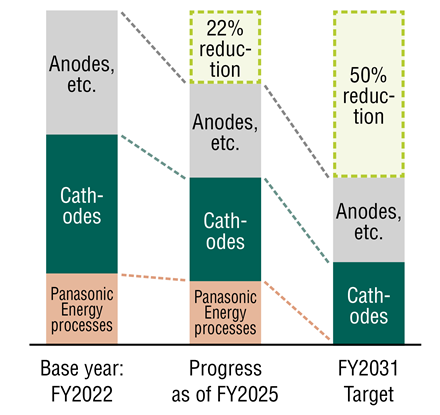
Furthermore, to reduce CO2 emissions across the entire supply chain, we are strengthening our reduction efforts both through internal initiatives and in cooperation with our suppliers with the goal of cutting our carbon footprint (CFP) per unit battery capacity in half*8 by fiscal 2031 compared to fiscal 2022.
*6 Manufacturing, research, and development sites that have achieved virtually zero CO2 emissions by conserving energy, introducing renewable energy, and using credits as of the end of the fiscal year.
*7 Number of sites assessed under the rules applicable before the change to the application of green electricity certificates in China—a change introduced by the Implementation Rules for the Management of Renewable Energy Green Electricity Certificates (Trial) enforced in November 2025. Reflecting this rule change, the number of sites would be 16.
*8 CO2 emissions per unit capacity of lithium-ion batteries for automotive use produced at the North American factory.
Progress and targets for CFP reduction
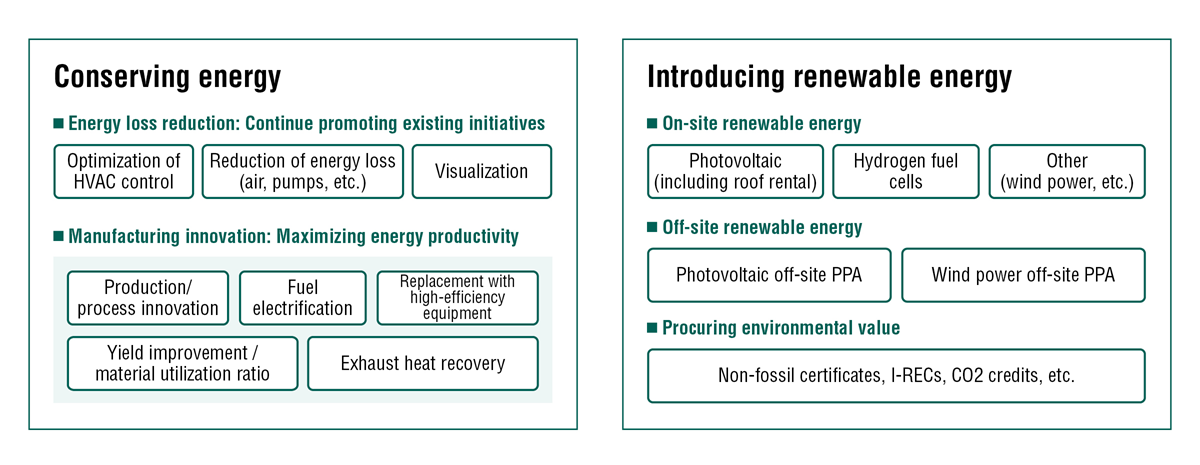
Initiatives in the battery production process
Conserving energy
Our battery production processes consume large amounts of energy through the use of equipment such as dryers and air-conditioning systems. To reduce environmental impact, we are implementing energy-saving measures such as optimizing air-conditioning control and reducing energy loss, while also driving manufacturing innovation through production and process innovations, as well as electrification and conversion of fuel sources.
As part of its efforts to improve production efficiency, our Kaizuka Factory established optimal drying conditions in the electrode plate production process using scientific methods, thereby increasing coating speed, leading to energy intensity reduction. This new process is also being deployed at the Kansas plant in the U.S., which began operations in July 2025.
As a result of this series of initiatives aimed at promoting net-zero factories at our in-house sites, in March 2026 Panasonic Energy Co., Ltd. and Panasonic Energy Kaizuka Co., Ltd. were awarded the Osaka Climate Change Countermeasures Award - Special Award (based on the evaluation of the submitted data). The award is based on the evaluation of performance reports submitted under Osaka Prefecture’s Ordinance on the Promotion of Climate Change Countermeasures.*9
Introducing renewable energy
In fiscal 2026, we have achieved Net Zero Factory status at 18 sites worldwide. Our next step is to increase our in-house renewable energy self-sufficiency rate*10 without relying on environmental certificates.
As one such initiative, we are working to install as much on-site renewable generation capacity as possible at our own sites. In many cases, a shortage of suitable land constrains where solar panels can be installed, so we are installing them not only on rooftops but also in parking lots, on building walls, and in other spaces. In February 2026, our Nishikinohama and Wakayama factories were assessed under JSA Standard S1024, “Evaluation method for the effective land use score for buildings equipped with solar panels,” issued by the Japanese Standards Association, and qualified as “Effective Land Use PV-Installed Buildings, etc.”*11
In addition, we installed solar carports over the parking lots at Panasonic Energy Nandan, Panasonic Energy Higashiura, and Panasonic Energy Wuxi. In doing so, we are reinforcing typhoon protection, optimizing installation angles to maximize power generation, and adopting bifacial solar panels. Furthermore, by adopting a new installation method during construction, we were able to reduce construction costs and shorten the construction period. These solar carports can also be used as shelter from rain and sun, contributing to greater employee convenience and better workplace amenities.
Going forward, we will consider expanding the introduction of renewable energy globally, taking into account the characteristics of each region in which we operate.
*10 An indicator showing the proportion of renewable energy supplied from in-house power generation facilities. Does not include electricity procured solely through electricity tariffs or certificates.
*11 Evaluated under JSA Standard S1024 “Evaluation method for the effective land use score for buildings equipped with solar panels.” A building projected to generate power efficiently for the land area it uses qualifies as an Effective Land Use PV-Installed Building, etc.
Wakayama Factory

Panasonic Energy Nandan

Panasonic Energy Wuxi

Panasonic Energy Higashiura

Introduction of off-site corporate PPAs
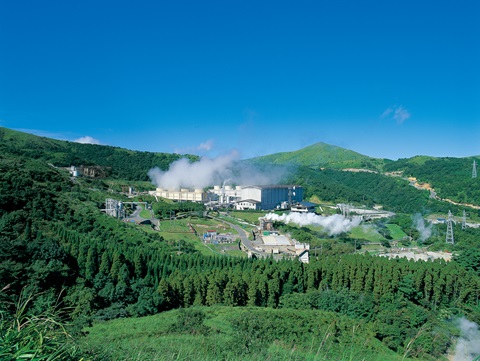
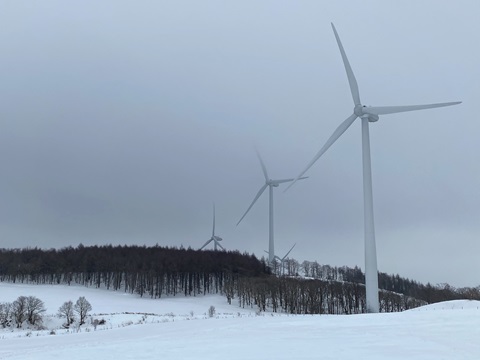
In addition to on-site photovoltaic power generation (including on-site PPAs), we have introduced off-site corporate PPAs*12 for solar and onshore wind power. Starting in April 2025, through our electricity retail subsidiary Panasonic Operational Excellence Company, we entered into an off-site corporate PPA with Kyuden Mirai Energy Corporation to procure renewable electricity from geothermal power. Because geothermal power can generate a stable supply of energy without being affected by weather conditions, this initiative will increase the in-house renewable energy self-sufficiency rate for our domestic electricity use from approximately 15% to about 30%*13. It has also yielded an annual CO2 reduction effect of around 50,000 tons—the equivalent of the annual CO2 absorption of approximately 56 km2 of forest (about 4,300 times the size of Koshien Stadium) *14.

Geothermal
Onshore wind
Solar
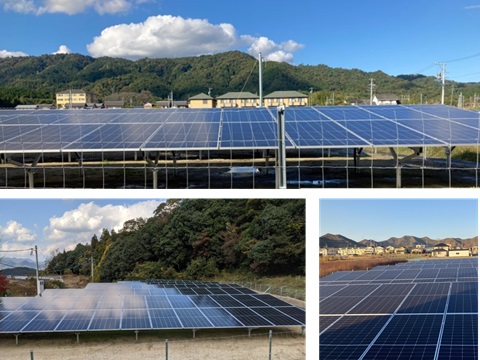
*12 A contractual arrangement in which the owner of a renewable energy source (including developers, investors, and others) and a purchaser of electricity (such as an end user) enter into an agreement to buy and sell renewable electricity at a pre-agreed-upon price and for a pre-agreed-upon term. Under this arrangement, renewable electricity generated at an off-site renewable energy facility located away from the point of consumption is supplied to the purchaser via the general power grid. (Source: Ministry of the Environment/Mizuho Research & Technologies, “About Off-site Corporate PPAs” *Japanese-language document only)
*13 Based on calculations using the actual electricity consumption at all of our domestic sites in 2024.
*14 Well-maintained, 36 to 40-year-old artificial cedar forests. (Data source: Forestry Agency website)
Optimizing our energy mix
We aim to achieve genuine decarbonization over the medium to long term without relying on CO2 credits, and are moving ahead with Scope 1 reductions to lower our dependence on fossil fuels. Specifically, we are reducing fossil fuel use at our existing factories by switching to electricity, mainly for air conditioning, various heating systems, and cafeteria equipment. In fiscal 2026, the Mexico Factory and the Panasonic Energy Nandan and Tsuna factories achieved zero fuel use. Furthermore, our Nevada Factory in North America operates as a 100% electrified factory that uses no fuel, as does the Kansas Factory, which came online in July 2025.
We will continue to reduce Scope 1 emissions and raise our electricity renewable energy ratio in stages, taking into account the energy supply situation in each region and usage at each factory.
Initiatives to utilize next-generation energy
We are promoting the use of hydrogen as a next-generation energy source that contributes to the reduction of CO2 emissions in society. We have introduced pure hydrogen fuel cells at our Nishikinohama Factory in Japan and at Wuxi Factory, China. The Nishikinohama Factory in particular has launched full-scale operation of an energy management system combining photovoltaic power generation and storage batteries equipped with our cells, and the amount of electricity supplied by renewable energy is expected to increase by up to approximately 1.5 times compared to conventional methods. At the 2025 World Exposition (Expo 2025 Osaka, Kansai, Japan), as part of an event under the theme "Change the Future! Hydrogen Week," we offered off-site visit tours*15 in partnership with Iwatani Corporation and Kawasaki Heavy Industries. Going forward, we will continue to contribute to decarbonization by utilizing next-generation energy.
*15 パナソニック エナジー、自社製蓄電池を活用し二色の浜工場で太陽電池・純水素型燃料電池・蓄電池の3電源連携エネルギーマネジメントシステムを本格運用開始 (*Japanese-language release only)
Nishikinohama Factory

Storage battery system equipped with our cells

Utilization of reused batteries
To minimize environmental impact, we are promoting the reuse of spent batteries.
At our Tokushima Factory, which achieved Net Zero Factory status in 2023, we are conducting demonstration tests on the installation of storage battery containers that utilize reused batteries. Specifically, we repurpose used batteries collected from data centers as high-voltage system modules, store electricity generated from solar panels, and use them to power nighttime lighting and other applications.
Going forward, we will promote the use of reused batteries for storage battery containers to expand the adoption of renewable energy, reduce CO2 emissions derived from product disposal, and lower environmental impact through waste minimization.

Storage battery container (Tokushima Factory)
Initiatives in raw material procurement
A large portion of the CO2 emissions associated with battery production occurs upstream of our manufacturing processes—in resource extraction, raw material processing, and logistics. To reduce environmental impact across the entire supply chain, we have set a target*16 to cut the CFP per unit of battery capacity by half from fiscal 2022 levels by fiscal 2031. This includes working with suppliers to reduce CO2 emissions in production processes, increasing the ratio of locally sourced materials, and reducing CO2 emissions in logistics, all while working to improve the data used to calculate our CFP. In fiscal 2026, these efforts resulted in a 30% reduction in CO2 emissions compared to fiscal 2022.
*16 CO2 emissions per unit capacity of lithium-ion batteries for automotive use produced at the North American factories.
Enhancing data for CFP calculation
We are upgrading the data behind our battery CFP calculations so they more accurately reflect upstream supply chain conditions. CO2 emissions from raw material manufacturing and processing vary with regional characteristics and production conditions. We therefore believe it is important to base calculations on data that captures the realities of each process, rather than relying solely on general statistics and averages. Based on this approach, we are gradually expanding our use of supplier data that reflects actual production and processing conditions for key raw materials. This gives us a clearer picture of which processes and factors contribute most to CFP, helping us work out improvements and plan and execute decarbonization measures across the entire supply chain more effectively.
Initiatives with suppliers
We work closely with suppliers to reduce CO2 emissions throughout all processes for the materials we use, from resource extraction to raw material processing and logistics. Through initiatives such as our annual Partners’ Meeting with suppliers, we ensure suppliers understand our policy and share what we aim for, with which we established a framework for collaboration to reduce CO2 emissions. As part of these efforts, based on the calculated CFP for batteries, we set reduction targets for key components and materials that will have the greatest impact. We often meet with suppliers to have concrete discussions on introducing high-efficiency equipment, optimizing production processes, adopting renewable energy, and procuring low-CFP raw materials. Going forward, we will position suppliers with low CO2 emissions (for example, those with a high share of renewable-energy use in the extraction of resources such as critical materials including nickel and lithium as well as raw material processing) as strategic medium- to long-term procurement partners. Through working together, we will reduce CO2 emissions. We will also collaborate with those suppliers to promote the introduction of renewable energy, use recycled materials, develop low-CO2-emission processes, reduce energy consumption, and carry out tree-planting and related activities.

Partners’ Meeting 2025
Initiatives to increase the ratio of locally sourced materials
Focusing on North America as a priority region, we are working to reduce the CFP of our batteries by increasing the ratio of locally sourced materials.
For natural graphite, in October 2022, we signed a memorandum of understanding for an offtake agreement (long-term supply agreement) with Nouveau Monde Graphite of Canada. Since then, we have advanced technological development and process optimization to meet our product specifications and quality standards, and in February 2024, we made an equity investment in the company and signed a seven-year offtake agreement. Canada’s high share of electricity from renewable sources such as hydropower, combined with its integrated production system from resource extraction to anode materials, has enabled procurement of anode materials with significantly reduced CO2 emissions.
For synthetic graphite, we have entered into a long-term supply agreement with Novonix, and since 2025, we have been conducting joint development for supply from the company’s Tennessee, U.S. factory to our North American factories. The company’s continuous graphitization furnace technology is expected to reduce CO2 emissions during synthetic graphite production compared to conventional methods. In addition to increasing the local procurement ratio in North America, we are also taking a strategic approach to reducing the environmental impact of our supply chain.
Furthermore, we have signed a long-term supply agreement with H&T Recharge for battery can cases. H&T supplies the can cases required for lithium-ion battery production from within the premises of our Nevada Factory. This on-site supply structure not only increases the local procurement ratio in North America but is also expected to reduce CO2 emissions associated with logistics by shortening transport distances for the can cases.
In addition, we are actively promoting the use of raw materials recovered from used lithium-ion batteries, further contributing to CO2 emission reductions.

NOVONIX continuous graphitization furnace (as of February 2024)
Initiatives in product distribution
Promoting green logistics
Logistics is both an area for reducing environmental impact and a critical business foundation supporting the stable supply of our products. For a company in the energy business, balancing environmental friendliness with reliable supply is essential, and we are working to reduce the environmental impact of product logistics as well. One of these initiatives is modal shift. Labor shortages, social infrastructure constraints, and other changes in the logistics landscape mean that depending on any single mode of transport could pose medium- to long-term risks. Our basic policy is to optimize the network as a whole, weighing transport lead times, demand fluctuations, business continuity planning, and other factors. We are expanding our use of rail and sea transport, working to reduce CO2 emissions and logistics risk at the same time.
These sustained efforts including the use of rail transport earned us the Eco-Rail Mark Excellent Business Operator Award at the 1st Eco-Rail Mark Awards, held in fiscal 2026.

Expanding our biogas truck fleet
We are introducing and expanding our use of trucks powered by biogas fuel, a renewable energy source, to reduce CO2 emissions in logistics. In fiscal 2025, we began trial runs with a heavy-duty biogas-powered truck to test its transport reliability, fuel economy, suitability for our routes, and other factors. The trials showed that the biogas-powered truck can match a conventional diesel in terms of load capacity and transport quality and confirmed the potential of producing virtually zero CO2 emissions on the road.
Drawing on the insights gained from these trials, we began putting the trucks into actual use in 2025 and are proceeding with full-scale rollout for regular transport. Working with our existing logistics network and partner companies, we manage operations to balance environmental impact reductions with transport quality, while staying mindful of costs.
Biogas*17 is a renewable energy produced from organic waste. By making effective use of waste, it helps reduce environmental impact. Going forward, we will also use rail transport and introduce next-generation eco-friendly vehicles, further advancing environmentally conscious logistics and helping to bring about a decarbonized society.
*17 Purified methane derived from biomass
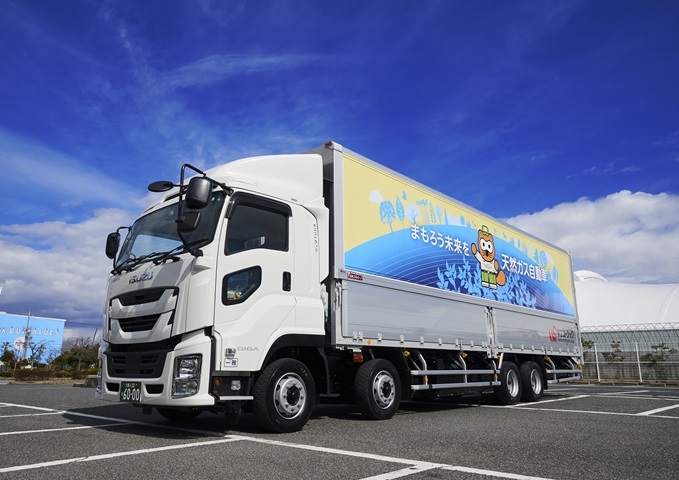
Biogas truck
Integrated Report
The Integrated Report is intended to help our various stakeholders deepen their understanding of our company by disseminating financial and non-financial information, including details of the management strategy, performance and financial status, and environmental, social and governance (ESG) initiatives.


