

Approach to Environmental Initiatives
Two material issues for realizing our Mission
Our Mission is to “Powering a society where shared well-being and environmental sustainability thrive together.” With this in mind, we believe that our fundamental value is to play a leading role in transforming society into a sustainable one. At the same time, we have a responsibility to reduce our own environmental impact as we fulfill this role.
Based on our approaches and the expectations of our stakeholders, we have identified two material issues related to the environment: “Achieving decarbonization” and “Realizing a circular society.” To maximize our contribution to the environment and minimize the environmental impact on each of these, we have set a total of six KPIs and their targets for fiscal 2031.

*1 The amount of CO2 emissions reductions achieved for our customers and society as a result of the introduction of our products, compared to the baseline level where no products were introduced. Calculate avoided CO2 emissions by estimating the reductions expected over the assumed service life of eligible products sold during the reporting year, and recognize the full amount in the year of sale.
Products Covered: Lithium-ion batteries for in-vehicle, electrically-assisted bikes, storage battery systems for data centers, ethical packaging, and alkali dry batteries.
*2 Manufacturing, research, and development sites that have achieved virtually zero CO2 emissions by conserving energy, introducing renewable energy, and using credits as of the end of the fiscal year
*3 Percentage of electricity used by Panasonic Energy that is derived from renewable energy sources (includes certificates, credits, and other externally procured items).
*4 CO2 emissions per unit capacity of lithium-ion batteries for automotive use produced at the North American factory.
With respect to the KPIs associated with the material issue “achieving decarbonization,” to expand avoided CO2 emissions from our products and solutions that are used by end users, we have set a target of 45 million tons of avoided emissions in fiscal 2031. We also aim to reduce CO2 emissions during battery production, including procurement of raw materials, production, and product distribution. To this end, we are pursuing initiatives such as expanding the number of our own net-zero-CO2 factories and increasing our electricity renewable energy ratio, with the goal of cutting our carbon footprint in half by fiscal 2031 compared to fiscal 2022.
With respect to the KPIs associated with the material issue “realizing a circular society,” to achieve our recycled material utilization rate KPI, we are strengthening our efforts to collect and recycle waste materials (from the production process) and used products, aiming to create a recycling loop through the reduction of natural resource consumption and waste. We believe that these initiatives will also contribute to reducing the carbon footprint of batteries.
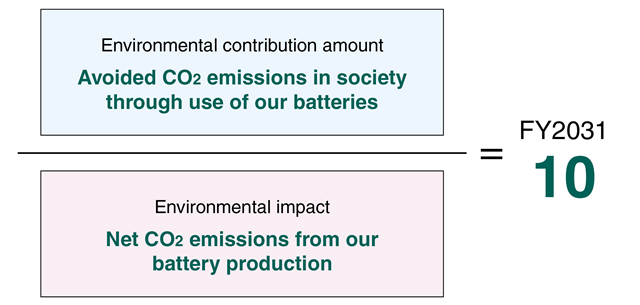
For these two material issues, we have established our own unique composite indicator, the "Environmental Contribution Index. The Environmental Contribution Index quantifies how many times greater our Environmental Contribution Index is than our environmental impact, as shown in the Environmental Contribution Index calculation formula. Our target is to achieve an Environmental Contribution Index of 10 by fiscal 2031 through maximizing our environmental contribution and minimizing the environmental impact of battery production.
Environmental Contribution Index calculation formula
Under the Group’s long-term environmental vision Panasonic GREEN IMPACT, last fiscal year we began disclosing information from the perspective of the Panasonic Group based on the TNFD framework in order to visualize our dependence on and impact on natural capital (including biodiversity) and accelerate the creation of sustainable corporate value.
This fiscal year, we started an analysis of our nature-related risks and opportunities based on the LEAP approach, focusing on our lithium-ion battery business, which is one of our growth areas.
Going forward, Panasonic will use this analysis as a starting point to gradually advance the sophistication of analysis and the enhancement of information disclosure. In addition, we will work to reduce, preserve, and recover from future impacts, further deepen TNFD disclosure, and enhance corporate value in the medium to long term.
Integrated Report
The Integrated Report is intended to help our various stakeholders deepen their understanding of our company by disseminating financial and non-financial information, including details of the management strategy, performance and financial status, and environmental, social and governance (ESG) initiatives.


