

Promoting Sustainability Management

The Panasonic Group has established its Basic Business Philosophy, which outlines its approach to management practices and the way employees carry out their work, and conducts its business based on this policy.
The Basic Business Philosophy (BBP) stipulates from the perspective of the environment and society that we make unparalleled contributions to solving global environmental problems, including climate change, and to the physical and spiritual health and well-being of people. Additionally, we will return the profits we obtain to society and invest in further contributions. From the perspective of governance, the BBP also stipulates autonomous responsible management, the practice of each employee’s entrepreneurship, maximizing human resources and management based on collective wisdom, and the principle of “Fairness and Honesty” including compliance.
As one of the operating companies in the Panasonic Group, Panasonic Energy will help resolve environmental and social issues through its corporate activities in accordance with the above ideas. At the same time, we are committed to promoting ESG-focused management in order to establish a transparent and fair management foundation, realize a sustainable society, and enhance medium- to long-term corporate value.
This is in line with our Mission, which is to “Powering a society where shared well-being and environmental sustainability thrive together.” and represents an essential initiative for us.
ESG promotion structure
Panasonic Energy established its ESG Committee, chaired by the President, to formulate an overall ESG plan, monitor its progress, and evaluate its achievement status. In addition, based on the outcomes of its deliberations, the Committee makes annual reports and recommendations to the Board of Directors to ensure that ESG considerations are integrated into the management decision-making process.
In promoting specific measures, we designate Executive Officer, or other person to take charge of addressing each of the seven material issues, set medium- to long-term visions and key performance indicators (KPIs), and formulate action plans to achieve them. Based on progress reports from the aforementioned persons in charge, the ESG Committee monitors and evaluates activities, estimates the effectiveness of measures, and encourages their improvements. In these ways, we have established the PDCA cycle throughout the year.
In fiscal 2026, we conducted a review of the previous fiscal year’s achievements and progress. We also reviewed the KPIs and targets that had been set for three years, making some changes to align them with the current situation. We also organized customer requests and regulatory requirements, established a cross-departmental project team to formulate response policies, developed action plans, and promoted their implementation. Among these efforts, we identified issues and carried out improvement activities aimed at ensuring compliance with the RBA Code of Conduct for the purpose of engaging in responsible business behavior. In fiscal 2027, we will deepen these initiatives further and promote activities aimed at achieving both materiality and KPI targets, as well as compliance with customer and regulatory requirements.
Material issues (materiality)
We have identified material issues (materiality) that we must address from an environmental, social, and governance (ESG) perspective in order to contribute to a sustainable society.
Materiality identification process
Panasonic Energy identified seven material issues using the following four steps.
Step.1 | List social issues | We listed 71 social issues that are candidates for materiality. |
|---|---|---|
Step.2 | Evaluate their importance from the perspective of Panasonic Energy | For each item on the list of social issues, we evaluated its impact on our business and relevance to our policies from Panasonic Energy’s perspective. |
Step.3 | Evaluate their importance from a stakeholder perspective | For each item on the list of social issues, we evaluated its importance from the perspective of all stakeholders, based on the opinions we have obtained through dialogue with stakeholders to date and the interest of investors and certifying organizations. |
Step.4 | Deliberate and identify | After sorting out our thoughts on ESG management and what we aim to achieve, we identified seven material issues through multiple rounds of deliberations between the officers, including the Representative Director, and staffs of the relevant departments. |
Materiality matrix
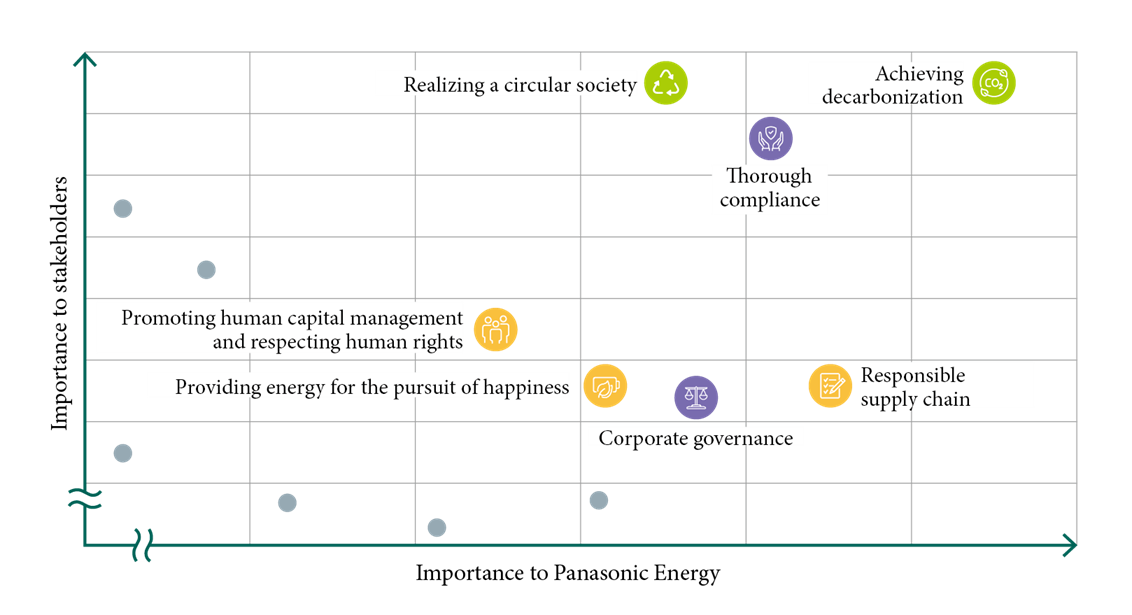
We evaluated social issues from two perspectives: their importance to Panasonic Energy and their importance to our stakeholders, and plotted the most important of these issues in the materiality matrix below
Seven identified material issues and specific examples of initiatives

We aim to achieve decarbonization by increasing our contribution to CO2 reductions through our products and reducing CO2 emissions from battery production.

We aim to realize a circular society by reducing the consumption of natural resources and the generation of waste through battery recycling and resource recovery from waste.

We contribute to the safety and security of society through our battery business and to the happiness of people’s lives through our community contribution activities.

We promote human capital management aimed at both strengthening business competitiveness and enhancing individual well-being, while also advancing initiatives to respect human rights and create rewarding workplaces.

We are building partnerships with suppliers globally and promoting the development of a sustainable supply chain that balances the pursuit of quality and competitiveness with social responsibility.

As a member of the Panasonic Group, we have established a board of directors and other important committees and are promoting to build and strengthen an effective corporate governance system.

We are working to ensure thorough compliance by pursuing quality and product safety, complying with laws and regulations, and maintaining information security.
Materiality KPIs and progress
The KPIs for the identified material issues, the targets for fiscal 2031, and the results achieved to date are shown below.

Dialogue with stakeholders
We place great importance on dialogue with a wide range of stakeholders around the world, including customers, investors, suppliers, governments, industry associations, NPOs and NGOs, local communities, and employees, and engage in dialogue at various stages of our operations. We also provide information on our activities to our stakeholders, and at the same time receive feedback from them regarding their expectations and concerns about us. We will incorporate such feedback into our business, product development, and ESG management activities to further enhance our corporate value.
Integrated Report
The Integrated Report is intended to help our various stakeholders deepen their understanding of our company by disseminating financial and non-financial information, including details of the management strategy, performance and financial status, and environmental, social and governance (ESG) initiatives.


