

Respecting Human Rights

Respecting Human Rights
Policy
The Panasonic Group has established the Panasonic Group Human Rights and Labour Policy, which refers to the content of the following international standards and incorporates the opinions of outside experts. The policy is predicated on compliance with international standards and the applicable laws in countries where we do business and includes our commitment to respecting internationally recognized human rights to identify, prevent, and correct risks related to human rights, to promote remedies for people affected by those risks, to create working environments where people are fulfilled by their work, and to engage in dialogue related to these topics with all our stakeholders. In accordance with this policy, we have established internal rules to develop a promotion system and promote specific initiatives for respecting human rights and creating working environments where people are fulfilled.
The Panasonic Group Code of Ethics & Compliance (Code of Ethics & Compliance) stipulates the promises that each employee must fulfill while also including respect for human rights as a part of our social responsibilities, and we are making efforts to raise awareness of them among all our employees.
<Main international standards used as reference>
■
The United Nations’ Guiding Principles on Business and Human Rights
■
The United Nations’ International Bill of Human Rights (Universal Declaration of Human Rights, International Covenant on Civil and Political Rights, and International Covenant on Economic, Social and Cultural Rights)
■
ILO Declaration on Fundamental Principles and Rights at Work and ILO Core Conventions


In addition, our Panasonic Supply Chain CSR Promotion Guidelines, which all suppliers are required to follow, call for respecting human rights.
Policy
The Panasonic Group has established the Panasonic Group Human Rights and Labour Policy, which refers to the content of the following international standards and incorporates the opinions of outside experts. The policy is predicated on compliance with international standards and the applicable laws in countries where we do business and includes our commitment to respecting internationally recognized human rights to identify, prevent, and correct risks related to human rights, to promote remedies for people affected by those risks, to create working environments where people are fulfilled by their work, and to engage in dialogue related to these topics with all our stakeholders. In accordance with this policy, we have established internal rules to develop a promotion system and promote specific initiatives for respecting human rights and creating working environments where people are fulfilled.
The Panasonic Group Code of Ethics & Compliance (Code of Ethics & Compliance) stipulates the promises that each employee must fulfill while also including respect for human rights as a part of our social responsibilities, and we are making efforts to raise awareness of them among all our employees.
<Main international standards used as reference>
■
The United Nations’ Guiding Principles on Business and Human Rights
■
The United Nations’ International Bill of Human Rights (Universal Declaration of Human Rights, International Covenant on Civil and Political Rights, and International Covenant on Economic, Social and Cultural Rights)
■
ILO Declaration on Fundamental Principles and Rights at Work and ILO Core Conventions
In addition, our Panasonic Supply Chain CSR Promotion Guidelines, which all suppliers are required to follow, call for respecting human rights.
Human rights due diligence
Overview of human rights due diligence initiatives
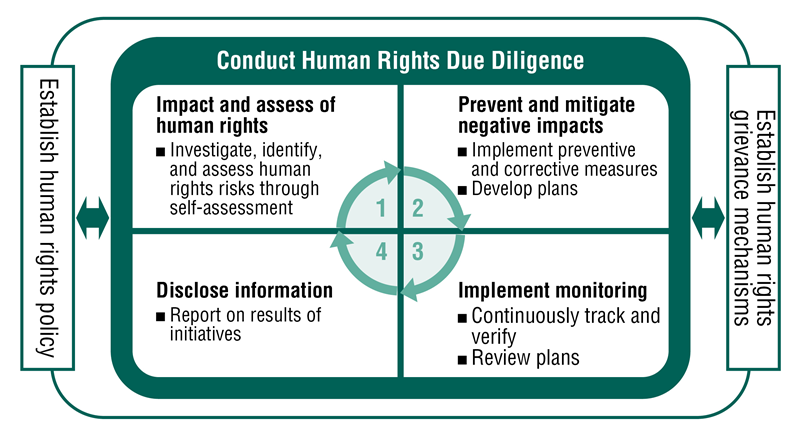
Panasonic Energy has established a Human Rights Due Diligence system based on the United Nations Guiding Principles on Business and Human Rights to respect and ensure the human rights of people associated with our business activities, products, services, and transactions. The system is intended to identify, prevent, and reduce negative impacts related to human rights with regard to the relevant business, correct issues, and explain the response results to the relevant stakeholders. Reflecting the issues that have been identified based on the requirements of society and the operation of the system, we continuously implement and improve the system with the advice of outside experts.
Risk assessment
Self-assessments at Group sites
From fiscal 2022, we utilized a self-assessment tool—based on the international standards of the Responsible Business Alliance (RBA) and the adaptation to our Company—to conduct self-assessments related to human rights and labour at our Group’s manufacturing companies. In fiscal 2023, we conducted a self-assessment focused on the International Labour Organization (ILO) core labour standards by using the questionnaires that we reviewed to identify issues more clearly, ensuring that both the implementation and correction rates were 100%. Continuing from fiscal 2024, in fiscal 2025, we conducted self-assessments at 16 manufacturing sites (6 in Japan and 10 overseas). Through this self-assessment, it has been confirmed that there were no cases that could be regarded as forced labour or child/juvenile labour. In the years to come, we will promote initiatives geared toward the prohibition of forced labour, the protection of children and young workers, the appropriate management of working hours and wages as well as the prohibition of discrimination to improve the working environment on an ongoing basis.
Key focus areas
- Prohibition of child labour and protection of young workers
The Panasonic Group Human Rights and Labour Policy clearly states our commitment to the effective elimination of child labour. When hiring employees, we comply with the laws and regulations of the relevant country or region. We also require recruitment agencies and other business partners to comply with these legal requirements. In addition, we prohibit workers under the age of 18 from engaging in night work, dangerous work, or heavy labour. - Prohibition of forced labour
The Panasonic Group Human Rights and Labour Policy explicitly prohibits all forms of forced labour. We respect the human rights of workers and, with reference to international standards and guidelines developed by organizations such as the ILO, work to establish hiring and employment environments free from forced labour and unfair treatment, in full compliance with all applicable laws, regulations, and internal rules. - Prohibition of discrimination and harassment
The Panasonic Group Human Rights and Labour Policy is committed to eliminating discrimination in employment and occupation. In addition, the Panasonic Group Code of Ethics & Compliance and other internal standards prohibit discrimination, discriminatory acts, and harassment based on factors such as age, gender, race, skin color, creed, religion, social status, nationality, ethnicity, marital status, sexual orientation, gender identity and expression, pregnancy, medical history, infectious disease status, genetic information, disability, political party affiliation or political beliefs, labour union membership, or military service history. We work to raise awareness of these issues to foster a workplace where diverse talent can respect one another as valued partners and thrive in an inclusive environment.
In recruitment and selection, we continue to raise awareness in line with the laws and guidelines of each country or region, ensuring that hiring decisions are based solely on the applicant’s suitability, abilities, and motivation. - Freedom of association and the right to collective bargaining
The Panasonic Group Human Rights and Labour Policy also commits to promoting the effective recognition of the freedom of association and the right to collective bargaining. In each country and region, we strive to build constructive relationships and resolve issues through active dialogue with employees. Even in countries where labour unions are not legally permitted, we work to find ways to uphold internationally recognized human rights principles in accordance with the Panasonic Group Human Rights and Labour Policy. - Occupational health and safety
The Panasonic Group Human Rights and Labour Policy also makes it a priority to provide a safe and healthy working environment. The policy reflects the inclusion of occupational health and safety in the ILO Core Labour Standards. - Appropriate management of working hours
In line with labour-related laws and regulations, as well as agreements between workers and management (such as labour agreements) in each country and region, the Panasonic Group sets rules in our work regulations for the proper management of working hours and breaks, overtime work, and days off. Forcing employees to work overtime without their consent is explicitly prohibited in our internal rules, as it constitutes forced labour or conduct that may be considered forced labour.
In addition to these systemic measures, we take a comprehensive approach to protecting employee physical and mental health, such as optimizing staffing to prevent excessive overtime for specific employees and providing consultations with industrial physicians and health guidance to any employees who engage in working long hours. - Appropriate management of wages
We have established guidelines for designing compensation systems to ensure competitive compensation levels in the market. In accordance with labour-related laws and regulations, as well as agreements between workers and management (such as labour agreements) in each country and region, we stipulate in our work regulations the appropriate payment of wages, allowances, bonuses, other ad-hoc payments, and retirement benefits.
We also establish country-specific rules in full compliance with all wage-related laws, such as minimum wage requirements, statutory benefits, and overtime pay. Based on these rules, wages are paid directly to employees within the designated pay period and on the specified dates, with notification provided through pay slips and electronic data.
Human rights due diligence
Overview of human rights due diligence initiatives
Panasonic Energy has established a Human Rights Due Diligence system based on the United Nations Guiding Principles on Business and Human Rights to respect and ensure the human rights of people associated with our business activities, products, services, and transactions. The system is intended to identify, prevent, and reduce negative impacts related to human rights with regard to the relevant business, correct issues, and explain the response results to the relevant stakeholders. Reflecting the issues that have been identified based on the requirements of society and the operation of the system, we continuously implement and improve the system with the advice of outside experts.
Risk assessment
Self-assessments at Group sites
From fiscal 2022, we utilized a self-assessment tool—based on the international standards of the Responsible Business Alliance (RBA) and the adaptation to our Company—to conduct self-assessments related to human rights and labour at our Group’s manufacturing companies. In fiscal 2023, we conducted a self-assessment focused on the International Labour Organization (ILO) core labour standards by using the questionnaires that we reviewed to identify issues more clearly, ensuring that both the implementation and correction rates were 100%. Continuing from fiscal 2024, in fiscal 2025, we conducted self-assessments at 16 manufacturing sites (6 in Japan and 10 overseas). Through this self-assessment, it has been confirmed that there were no cases that could be regarded as forced labour or child/juvenile labour. In the years to come, we will promote initiatives geared toward the prohibition of forced labour, the protection of children and young workers, the appropriate management of working hours and wages as well as the prohibition of discrimination to improve the working environment on an ongoing basis.
Key focus areas
- Prohibition of child labour and protection of young workers
The Panasonic Group Human Rights and Labour Policy clearly states our commitment to the effective elimination of child labour. When hiring employees, we comply with the laws and regulations of the relevant country or region. We also require recruitment agencies and other business partners to comply with these legal requirements. In addition, we prohibit workers under the age of 18 from engaging in night work, dangerous work, or heavy labour. - Prohibition of forced labour
The Panasonic Group Human Rights and Labour Policy explicitly prohibits all forms of forced labour. We respect the human rights of workers and, with reference to international standards and guidelines developed by organizations such as the ILO, work to establish hiring and employment environments free from forced labour and unfair treatment, in full compliance with all applicable laws, regulations, and internal rules. - Prohibition of discrimination and harassment
The Panasonic Group Human Rights and Labour Policy is committed to eliminating discrimination in employment and occupation. In addition, the Panasonic Group Code of Ethics & Compliance and other internal standards prohibit discrimination, discriminatory acts, and harassment based on factors such as age, gender, race, skin color, creed, religion, social status, nationality, ethnicity, marital status, sexual orientation, gender identity and expression, pregnancy, medical history, infectious disease status, genetic information, disability, political party affiliation or political beliefs, labour union membership, or military service history. We work to raise awareness of these issues to foster a workplace where diverse talent can respect one another as valued partners and thrive in an inclusive environment.
In recruitment and selection, we continue to raise awareness in line with the laws and guidelines of each country or region, ensuring that hiring decisions are based solely on the applicant’s suitability, abilities, and motivation. - Freedom of association and the right to collective bargaining
The Panasonic Group Human Rights and Labour Policy also commits to promoting the effective recognition of the freedom of association and the right to collective bargaining. In each country and region, we strive to build constructive relationships and resolve issues through active dialogue with employees. Even in countries where labour unions are not legally permitted, we work to find ways to uphold internationally recognized human rights principles in accordance with the Panasonic Group Human Rights and Labour Policy. - Occupational health and safety
The Panasonic Group Human Rights and Labour Policy also makes it a priority to provide a safe and healthy working environment. The policy reflects the inclusion of occupational health and safety in the ILO Core Labour Standards. - Appropriate management of working hours
In line with labour-related laws and regulations, as well as agreements between workers and management (such as labour agreements) in each country and region, the Panasonic Group sets rules in our work regulations for the proper management of working hours and breaks, overtime work, and days off. Forcing employees to work overtime without their consent is explicitly prohibited in our internal rules, as it constitutes forced labour or conduct that may be considered forced labour.
In addition to these systemic measures, we take a comprehensive approach to protecting employee physical and mental health, such as optimizing staffing to prevent excessive overtime for specific employees and providing consultations with industrial physicians and health guidance to any employees who engage in working long hours. - Appropriate management of wages
We have established guidelines for designing compensation systems to ensure competitive compensation levels in the market. In accordance with labour-related laws and regulations, as well as agreements between workers and management (such as labour agreements) in each country and region, we stipulate in our work regulations the appropriate payment of wages, allowances, bonuses, other ad-hoc payments, and retirement benefits.
We also establish country-specific rules in full compliance with all wage-related laws, such as minimum wage requirements, statutory benefits, and overtime pay. Based on these rules, wages are paid directly to employees within the designated pay period and on the specified dates, with notification provided through pay slips and electronic data.
Grievance mechanism
The Panasonic Group has established a global hotline (available in 32 languages) for employees and external stakeholders, including business partners, so that complaints regarding human rights violations can be addressed promptly and remedies made possible. Individuals may report if they have suffered harm from, or have witnessed or become aware of, compliance violations, including those involving human rights and labour issues. The mechanism uses an independent external system to avoid identifying reporters and to ensure the strict confidentiality of reports. Our internal regulations also stipulate that reporters, whether inside or outside the company, will not be subject to retaliation or disadvantageous treatment for filing a report.
Grievance mechanism
The Panasonic Group has established a global hotline (available in 32 languages) for employees and external stakeholders, including business partners, so that complaints regarding human rights violations can be addressed promptly and remedies made possible. Individuals may report if they have suffered harm from, or have witnessed or become aware of, compliance violations, including those involving human rights and labour issues. The mechanism uses an independent external system to avoid identifying reporters and to ensure the strict confidentiality of reports. Our internal regulations also stipulate that reporters, whether inside or outside the company, will not be subject to retaliation or disadvantageous treatment for filing a report.
Implementation of human rights education
We provide training in 22 languages of our Code of Ethics & Compliance, including “Respecting Human Rights,” and provide regular opportunities (including when first starting work and upon promotion) to ensure that employees fully comprehend the topic of respect for human rights included in the Code. In fiscal 2023, we revised the Code of Ethics & Compliance and began conducting training on the Panasonic Group Code of Ethics & Compliance for all employees. We also provide training to all individuals, including executives, who will be dispatched from Japan to overseas posts to deepen their understanding of international standards and local laws and regulations concerning the corporate responsibility to respect human rights, as well as to deepen their understanding of the Panasonic Group Human Rights and Labour Policy and related initiatives.
In addition, as part of our efforts to improve understanding of ESG issues, we have conducted video-based training on social issues related to human rights and our initiatives. We also administer a comprehension test, which we use to plan future training programs.
Implementation of human rights education
We provide training in 22 languages of our Code of Ethics & Compliance, including “Respecting Human Rights,” and provide regular opportunities (including when first starting work and upon promotion) to ensure that employees fully comprehend the topic of respect for human rights included in the Code. In fiscal 2023, we revised the Code of Ethics & Compliance and began conducting training on the Panasonic Group Code of Ethics & Compliance for all employees. We also provide training to all individuals, including executives, who will be dispatched from Japan to overseas posts to deepen their understanding of international standards and local laws and regulations concerning the corporate responsibility to respect human rights, as well as to deepen their understanding of the Panasonic Group Human Rights and Labour Policy and related initiatives.
In addition, as part of our efforts to improve understanding of ESG issues, we have conducted video-based training on social issues related to human rights and our initiatives. We also administer a comprehension test, which we use to plan future training programs.
Integrated Report
Integrated Report

