

Promoting Human Capital Management

Policy
To realize Panasonic Energy’s Mission and Vision, the Company positions human resources as the most important management asset and aims to both strengthen business competitiveness and improve individual well-being.
These aims result in the Company stating as follows: (1) a diverse group of people who strongly resonate with our Mission and Vision and who are autonomously taking on the challenges of achieving them and (2) a safe and secure environment in which these people can maximize their abilities to create a competitive advantage over other companies. In fiscal 2026, we advanced initiatives on two major pillars: fostering individuals who take on challenges autonomously, and fostering an organization and culture that enables employees to reach their full potential.
In addition, in today's rapidly changing business environment, we are working to optimize our management resources in line with our business strategy in order to achieve sustainable growth and maximize corporate value. Above all, human capital is the most important management resource that supports our competitiveness and growth, which is why we are pursuing talent portfolio management from a medium- to long-term perspective.
Optimizing management resources to adapt to changes in the business environment
Talent portfolio management in practice
Taking into account the business environment surrounding Panasonic Energy as well as our business strategy, we are transforming our talent portfolio from the perspective of company-wide optimization. We are strengthening the alignment between our business strategy and human resources strategy, clarifying the ideal talent profile needed for future business growth, and then documenting the gap between that profile and our current workforce.
Furthermore, in order to achieve the optimal allocation and composition of both the quality and quantity of human resources globally, we are strategically and flexibly implementing measures for recruitment, training, placement, and utilization. Rather than merely adjusting staffing allocation, we aim to build an organizational foundation resilient to environmental change by continuously transforming our talent structure in line with changes in our business structure.
To promote these initiatives as a unified management effort, we have established a Resource Management Committee (RMC). Senior management participates in the RMC meetings, where important cross-cutting issues related to human resources are discussed.
The RMC has two major responsibilities: (1) As a management team, establish a common understanding of current resource issues and define an ideal resource structure with an eye on the future business environment; and (2) Discuss and set the direction of strategies and measures to achieve that, and continuously evaluate their effectiveness globally from both quantitative and qualitative perspectives, using the results to drive improvements.
Through these mechanisms, we will implement proactive management decisions and resource allocations that anticipate changes in the business environment, thereby achieving sustainable growth and enhancing corporate value over the long term.
Individuals who take on challenges autonomously
Identifying and developing management executives who will drive Panasonic Energy's future
In the Company’s rapidly changing business environment, it is essential to have management executives who can drive business growth by responding to these environmental changes flexibly and quickly from a medium- to long-term perspective. To this end, we are promoting the development of a robust pipeline of next-generation management personnel. To realize our mission, we need management executives who have an unwavering resolve to shoulder the future, who are committed to continuous self-improvement, and who can lead management in a manner that is true to the Company. We have established the fundamental requirements expected of Panasonic Energy's management executives ((1) behavior [competency], (2) interpersonal skills [potential], and (3) skills, knowledge, and connections) and aim to continuously cultivate next-generation management personnel who can acquire and demonstrate these requirements.
Specifically, we define succession requirements for business division directors (who are executive officers) and CxO positions as target positions, while also selecting succession candidates from short-, medium-, and long-term perspectives.
Then, once the abilities and skills that candidates need have been identified by working backward from the successor requirements, career development plans centered on challenging assignments that will achieve dramatic growth are thoroughly discussed and implemented by our talent management committee comprised of the President, the business division directors, and the CTO, CMO, and CHRO.
Furthermore, to secure diverse next-generation management personnel sufficient in quality and quantity, we have systematized a talent review process based on the requirements expected of the Company's management executives, and we are actively working to identify candidates at a young age and to provide them with new experiences through a combination of on-the-job training (OJT) and off-the-job training (Off-JT) to foster their early development.
In terms of Off-JT programs to support the career development of management succession candidates, we offer a variety of executive development training programs including practical training in making management recommendations and management training for technical and manufacturing leaders. In particular, in the areas of technology and manufacturing, which are one of the sources of our competitiveness, we are not only deepening our technology and manufacturing capabilities, but also developing human resources who can formulate management strategies based on our technological and manufacturing competitiveness and create innovation.

Manufacturing leaders who can engage in discussions with management executives
Strengthening training and revamping onboarding programs for new employees
In light of the rapidly changing business environment and the need to enhance our competitiveness in the medium to long term, Panasonic Energy has revamped its onboarding program for new graduates starting in fiscal 2026. This program is one of our core initiatives aimed at fostering "individuals who take on challenges autonomously," based on our policy of positioning human capital as our most important management asset.
Previously, the training period was three years. After the overhaul, the first five years after joining the company are now designated as a period of focused training. The revamped program is now known as the "Energy Professional Program," which supports growth from a more medium- to long-term perspective. The goal of the program is to equip employees with the skills to perform their duties effectively from an early stage, while simultaneously building a foundation as professionals who will drive the business forward in the future.
This program defines the goal for new graduate hires five years after joining the company as becoming professionals who can compete internationally on the strength of their own expertise and reputation. The goal of this program is to cultivate talent who can autonomously create value by assessing the environment surrounding Panasonic Energy from three perspectives—industry, nation, and competitors—and by flexibly responding to changes in business strategy.
In designing the training system, we defined the essential competency requirements particularly needed for young talent based on a survey of top executives. Each year's training program is structured to enhance these abilities progressively and systematically.
Specifically, in the first year, in addition to the new employee orientation training, we conduct training to help employees understand the competitive environment and encourage behavioral change, as well as training to cultivate the ability to autonomously set and execute tasks, and negotiation and bargaining skills. From the second year onward, the training sessions deepen employees' understanding of social and customer value and strengthen their resilience. In the third year, we conduct training to enhance leadership skills. Then, in the fourth and fifth years, employees refine their ability to innovate through practical project-type training, including exposure to cutting-edge fields through site visits and drafting transformation plans based on business challenges.
The training aims to cultivate three key attitudes: competitiveness, sense of responsibility, and a change-oriented mindset. At the same time, we have put in place a system that, through dialogue with and feedback from supervisors and mentors, enables each person to reflect on their own growth and proactively shape their career vision.
With this revamped onboarding program, we aim to achieve both early success and long-term growth for new graduates, simultaneously improving individual well-being and strengthening our business competitiveness. Going forward, we will continue to invest in human capital to achieve sustainable enhancement of corporate value.
Developing battery industry talent
Considering five years as the training period for new graduates, we conduct the new employee onboarding program to ensure they acquire the skills necessary for their work. We have introduced a mentor system and put in place a system by which senior employees with whom they are familiar are able to provide consultation and support for concerns related to their non-work lives and careers. This initiative is not limited to just training new employees; instead, it is also positioned as a place for the mentors themselves to gain insights and broaden their opportunities to learn and grow.
Mid-career recruits are able to adapt smoothly to our culture and climate through the career joining onboarding program and, for example, through opportunities for communication with management, the understanding of our mission and vision, and Group management philosophy training. We are working to make the most of the individuality, desire, and ability that each person possesses.
In addition, we offer a Basic Battery Course to a diverse group of recruits who are joining the Company, helping to support the rapid integration of new graduates and mid-career recruits from other industries into our workforce. We have also established a framework for enhancing training delivered by technical experts and strengthening practical skills. Recently, we have implemented four improvements to the Basic Battery Course: (1) Established a new "quality faculty" (to supplement the existing technology, production technology, and manufacturing faculties) aimed at improving quality awareness; (2) Systematized safety and environmental education; (3) Expanded the target audience of the lithium-ion battery (LIB) assembly workshop (to all approximately 200 new hires); and (4) Boosted the transmission of advanced skills, including tacit knowledge (expanded practical training using equipment and tutoring activities). As a result, the number of courses has expanded to 208 (an increase of 176 compared to the initial number).
Furthermore, with the aim of enabling students to gain a broad and deep understanding of the battery business and its current state of development, we launched the Battery Industry Talent Development Program at Osaka Metropolitan University. We are also offering on-site LIB assembly workshops to technical colleges and high schools.
Going forward, we will continue to evolve the Academy of Battery Technology & Manufacturing into a knowledge platform for battery development that supports sustainable value creation.
Supporting the growth of battery industry talent through the Panasonic Energy MIRAI Scholarship program
Our Mission is to “Powering a society where shared well-being and environmental sustainability thrive together.” To fulfill this Mission and to cultivate personnel that will contribute to the development of the battery industry, in fiscal 2025 we established the MIRAI Scholarship program. The aim of the program is to support human resources who can make a significant contribution to the development of the battery industry in the future. The scholarship winners chosen by the selection committee are awarded a one-year grant of 500,000 yen and provided with an environment in which they can concentrate on their research activities.
The program also enables our engineers at the front lines of the battery business who are active globally to build ongoing connections with scholarship winners. To support their future plans, scholarship winners are given access to our in-house community of engineers and given opportunities to interact with current engineers, which allows them to learn about the benefits of working at a battery manufacturer, to receive advice on research activities, and to brainstorm about their future vision. Through this scholarship program, we will continue to actively support the development of future battery industry personnel who will achieve its Vision: “Be the energy that shapes the future.”
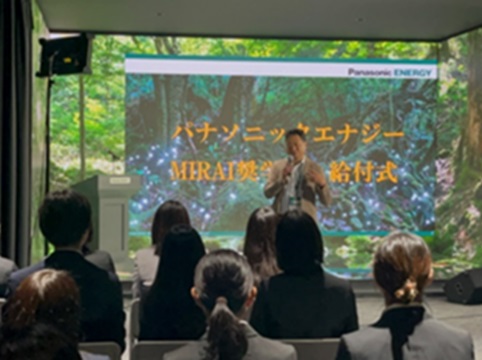
Scholarship award ceremony
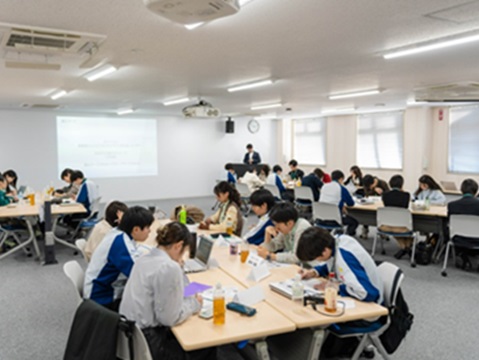
Exchange with in-house engineers
Creating an environment that encourages employees to take on challenges proactively
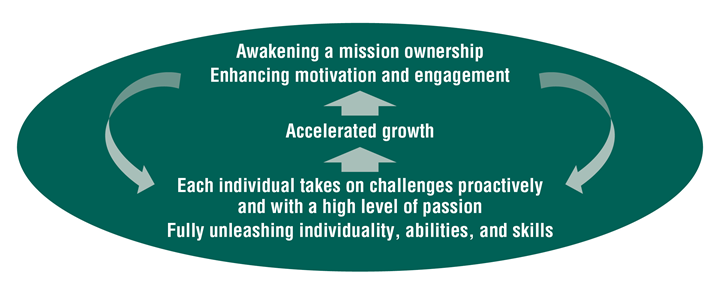
We are working to create systems and environments that foster a "cycle of continuous challenge and growth” in which employees challenge themselves to achieve high goals and are adequately rewarded for their achievements, further increasing their motivation to take on the next challenge and accelerating growth. By supporting every employee’s individual effort to challenge themselves and grow, we maximize the value of our human resources.
In fiscal 2025, we revised our goal management system to include "challenging goals" which are ambitious initiatives that cannot be achieved by simply extending our past and present. We also transitioned to a role- and job-based human resource management for managerial positions, revised our remuneration levels and systems based on market value, and launched the Middle and Senior Partnership Program (an extended employment system) to extend the retirement age to 65 years old for applicants who meet certain job and personnel requirements.
Starting in April 2025, we made revisions to the performance evaluation system for general employees (non-managers) and re-employed retirees, with the goal of assessing both the processes and outcomes of the challenges they undertake in greater detail and linking these evaluations more effectively to further growth. We also made revisions to the compensation system to strengthen differentiation based on results and ensure fair returns. At the same time, we enhanced evaluation skills training for department and section managers (which had started in fiscal 2025) and expanded its coverage to include assistant managers. By ensuring proper operation and use of these systems in each workplace, we are working to increase confidence in evaluations, strengthen the link between evaluation and development, and create an environment where individuals can maximize their capabilities.
To accommodate diversifying values and working styles, we introduced a discretionary work hour system on a trial basis starting in fiscal 2026. The system increases employees' discretion over their working hours within certain limits, while prioritizing the prevention of overwork and ensuring their health. Eligible employees are provided with a remuneration system that provides incentives based on performance and results, instead of allowances based on overtime hours. In fiscal 2027, we plan to pursue full-scale implementation, including revising the system to make it more flexible, after identifying and examining employee needs and problems in the trial run. By providing options for working styles that allow individuals to pursue results without being constrained by time, we will create an environment where each and every employee can demonstrate their individual abilities to the fullest.
We also offer an external side job system alongside our internal and Group-wide job transfer (open recruitment) and side job systems. By accommodating employees’ desire to take on a broader range of challenges and grow, we will support them in acquiring diverse experiences, accelerating their growth, and realizing the career goals they aspire to.
Continuous cycle of challenge and growth
Supporting career realization and promoting human resource development
To help individuals realize their medium- to long-term career vision, we support them in developing the career they desire.
At Panasonic Energy, we formulate individual human resource development plans for the autonomous career and skill development of all employees through regular one-on-one meetings between superiors and subordinates. We also support development and growth by providing—irrespective of role, age or gender—a variety of training opportunities that meet the motivation of each individual to learn.
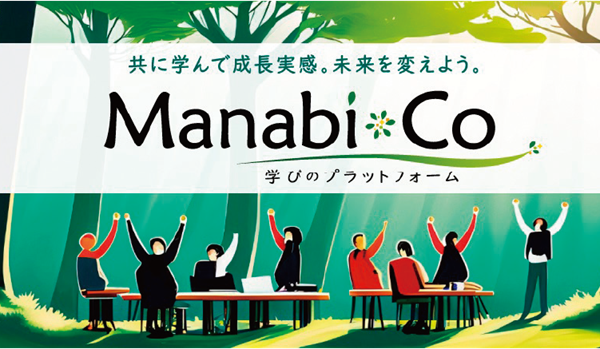
Beginning in fiscal 2025, we fully implemented the Learning Management System called “Manabico” to visualize the development system and centrally manage various training courses, and started supporting employees’ autonomous learning. We will continue to support learning by enhancing content to support each individual’s autonomous career development.
We continuously listen to concrete proposals and requests from the workplace and use these insights to identify issues and launch initiatives toward solutions. We are also actively investing in human resource development for the next generation of executives and middle management, who are key personnel in workplace management, promoting recurrent education to support the active participation of motivated human resources regardless of their age, and responding to employees’ strong desire for personal growth.
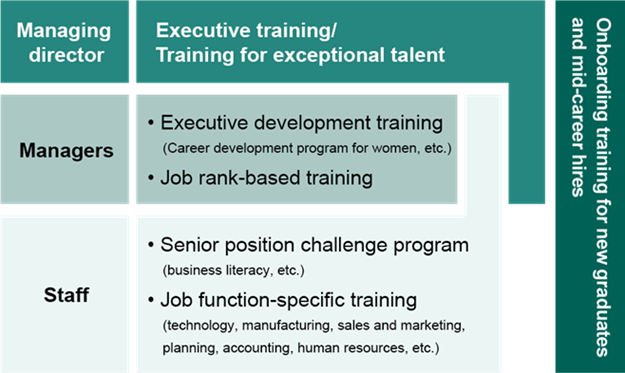
Our education and training system is based on the acquisition of management philosophy, knowledge and skills that are commonly required of all employees. We also have systematized, rank-based training according to the growth of each individual and specialized training by function to hone their expertise in the tasks of which they have been placed in charge. We are developing learning on a global basis by enhancing and upgrading online learning that enables learning with high-quality teaching materials regardless of time and place. At the same time, we are working on the matching of business management and human resource development by, for example, individually developing customized training in accordance with business needs. Based on training courses at an in-house training institution, we are currently conducting human resource development training sessions, such as specialized training and external training, in accordance with personal growth.
Basic education and training system
Creating an organization and culture that enables employees to reach their full potential
Towards the fulfillment of the Mission/Vision
Since Panasonic Energy was established in fiscal 2023, we have held The Forest Conference with the aim of instilling our Mission/Vision/Will (MVW) and the Seven Pillars of Transformation. The forest represents a world where living beings and nature coexist in harmony. By placing participants in that setting, The Forest Conference provides a space to experience firsthand the kind of world we outline in our mission—to realize a society in which the pursuit of happiness and a sustainable environment are in harmony without any contradiction —and to engage in discussions with colleagues about how to achieve our goals, leading to a transformation in personal behavior.
The Forest Conference began with the participation of executives and middle management. By the end of fiscal 2026, we had held a total of 64 sessions with 918 employees taking part. Each session involves around 15 participants, with executives serving as chairs and leading ongoing cross-departmental discussions on MVW and the Seven Pillars of Transformation and instilling a mission ownership. For fiscal 2027, we plan to hold 9 sessions with approximately 180 participants.


In addition, in October 2024, To accelerate the penetration of MVW, we established a "Mission Ownership Taskforce " as a new organization directly under the President. At the Mission Ownership Taskforce, 17 leaders and more than 100 members selected from each department take the lead in planning and implementing cross-Company initiatives intended to inspire each employee to deeply identify with MVW, draw on a strong sense of mission ownership, and utilize their own individuality, ability, and skills to the fullest, and to evolve the Company into one that takes on challenges autonomously to achieve its Mission. As an example, in fiscal 2026 we implemented and utilized a company-wide system that allows employees to express gratitude and praise to one another. Fostering a culture in which employees acknowledge one another's challenges and contributions makes them feel that their own actions are contributing to realizing the mission, creating a chain of positive actions.


Mission Ownership Taskforce activities: Once a month, leaders and members selected from each department gather to actively discuss and implement specific activities
Fostering a culture of dialogue
To translate understanding and empathy for MVW into action, we emphasize two-way dialogue. In fiscal 2026, we positioned fostering a culture of dialogue as a key theme and actively created opportunities for two-way communication between management and employees. Specifically, we held ongoing forums for dialogue intended to create a ripple effect throughout the organization—such as company-wide town hall meetings and small-group roundtables—to share management’s thinking and the background to its decisions, and to have management directly respond to employees’ opinions and questions. As a result, MVW is evolving from something that is simply communicated to employees into something they embrace as their own, think about, discuss, and act on. Through these dialogues, mutual understanding across departments and roles is progressing, fostering a culture of autonomous thinking and embracing challenges, and cultivating an environment that embraces diverse opinions and integrates them as an organizational strength.
Supporting the success of diverse human resources
In Japan, we promote the DEI (Diversity, Equality, and Inclusion) initiative with the goal of creating a company where a diverse group of employees can coexist in harmony, individuals will be happy and fulfilled in their work, and the environment will be conducive to sustainable challenges.
We are building an organization and environment where diverse talent can create value. Our goal is to become a collective filled with people eager to take on challenges, whether they joined us as new graduates, mid-career hires, or through transfers within the Group, with each demonstrating their own abilities through their unique experiences and backgrounds.
In Japan, increasing the percentage of women in our company, we will expand and improve opportunities for all employees to take on challenges, and aim in order to further raise the proportion of women in managerial positions (7.1% as of the end of fiscal 2026). To encourage the taking on of such challenges, we identify underlying issues through employee surveys and interviews, while also providing opportunities to reflect on self-understanding and career planning and offering coaching to drive action.
In addition, to expand opportunities for employees with disabilities, we have not only increased employment through Panasonic Farm*1 but also launched Office Concierge operations in October 2024. The Office Concierge is a team dedicated to supporting colleagues by taking on tasks that employees find difficult or would benefit from assistance with. This includes PC-based work such as data entry and document preparation, administrative support such as equipment management, and general office operations support.
*1 We aim to create a workplace where staff with disabilities can play an active role in vegetable production.
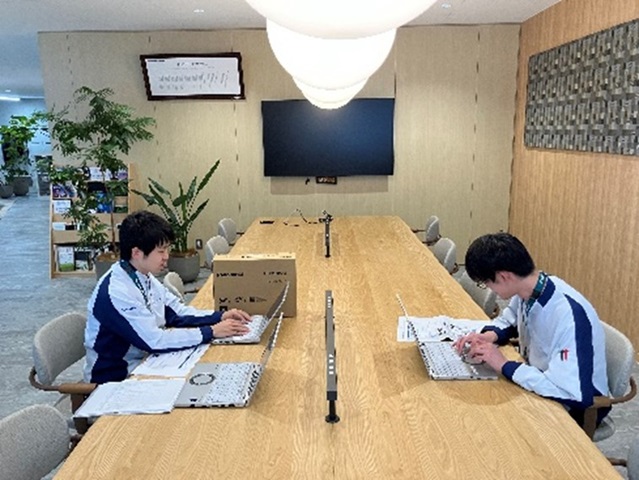
Office Concierge team member setting up a computer for a new employee
Promotion of paternity leave
To realize an approach to management that enables employees to reach their full potential and determines their growth on an individual basis, we emphasize the need for balance between life events and career development. As a result, we are moving forward toward the evolution of work styles and creating environments that maximize the value of human resources and match the diversity of lifestyles and value sets. Specifically, we will increase the rate of childcare leave taken among men (84% in fiscal 2026), expand options for work locations, and reform the promotion screening process.
In particular, we encourage male employees to take childcare leave by holding explanatory meetings once a month for those who plan to take leave and send follow-up e-mails to those who are eligible. Furthermore, in October 2025, we introduced childcare leave, primarily to expand the options for employees in workplaces with fixed working hours, such as those working shifts at manufacturing sites.
To address the needs of employees with diverse value sets and backgrounds, we are designing mechanisms that encourage them to challenge difficult goals and smoothly produce outcomes, namely by allowing each employee to select the ideal work style for their individual circumstances. Specifically, we are establishing an environment that conforms to their various working needs, such as the fully remote work system to increase the flexibility of work locations, enhancing leave systems, and revising the housing system to address various lifestyles. In addition, we are establishing horizontal connections between departments through the use of IT systems and designing mechanisms to promote community activities and invigorate interactions between human resources.
Promoting understanding of unconscious bias
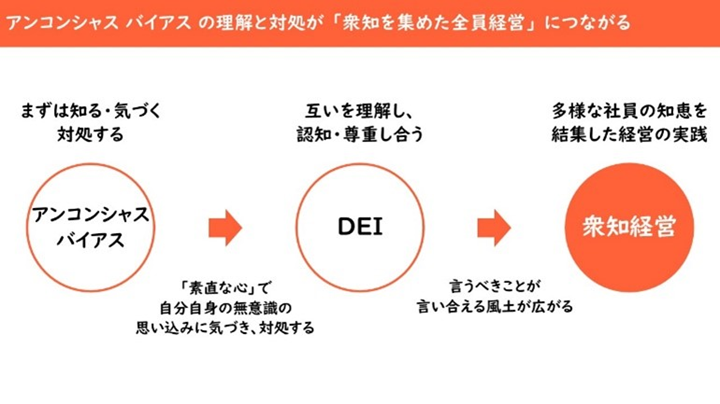
We understand that understanding unconscious bias is essential for creating an environment where diverse talent can thrive, and provide employee training on this topic. Unconscious bias refers to the tendency to form biased perspectives unconsciously based only on past experiences or what one has seen or heard. In this training, each participant learns about their own unconscious biases, becomes aware of them, and reflects on their own words and actions.
Practicing participative management through collective wisdom by incorporating unconscious bias training (from training materials, Japanese-language materials only)
Supporting department and section managers in personnel and organizational and personnel management
To adapt to changes over the medium to long term, strengthen corporate competitiveness, and continue delivering value to customers, it is essential to evolve organizational management and create an environment where each employee can fully utilize their abilities.
Within the Panasonic Group, an annual employee opinion survey is conducted to assess organizational management. At Panasonic Energy, we have gone further, introducing an organizational management tool (Motivation Cloud) at all domestic sites starting in fiscal 2025 to assess the state of organizations more frequently and in greater detail. Three organizational surveys are conducted each year, and the results are used to set priorities for addressing issues. For organizations with the highest-priority issues, we carry out improvement initiatives with support from external experts.
For managers at the department and section head levels, we provide basic training on organizational development to strengthen their organizational management skills and help build self-directed, autonomous organizations. In addition, opportunities for personal coaching are on offer for up to 100 managers who request it. By supporting managers in balancing increasingly complex business operations with organizational management, we enable them to gain sharper insight into the needs of their organizations and resolve issues more quickly. These initiatives will continue in fiscal 2027.
Building a foundation of safety, security, and health
Creating safe and secure workplaces
To create safe and secure workplaces, the Company has set its global KPIs as zero fatalities due to occupational accidents and zero lost time incidents. In fiscal 2026, there were no fatalities due to occupational accidents, but there were 16 lost-time incidents. Therefore, we are continuing to promote the Emergency Safety Measures Project.
We launched this project in fiscal 2025 after classifying the occurrence of accidents related to equipment safety or chemical substances as an "Emergency" to thoroughly strengthen measures to prevent occupational accidents, and we are continuing to carry out company-wide activities aimed at eradicating occupational accidents. We are also continuously working to further enhance the risk sensitivity and safety awareness of each and every employee.
With regard to disaster preparedness, we are implementing physical countermeasures against natural disasters such as massive earthquakes and wind and flood damage in buildings and equipment, while at the same time working to raise awareness among employees through disaster preparedness awareness activities. In this way, we are implementing measures to ensure the safety of our employees.
Thorough strengthening of occupational accident prevention measures: Emergency Safety Measures Project
Thorough strengthening of occupational Glossary accident prevention measures: Emergency Safety Measures Project
We are also sharing examples of occupational accidents that have occurred within the Company, thoroughly investigating the causes of occupational accidents and measures to prevent any recurrence, and developing activities to prevent recurrence at each business site.
As part of the Emergency Safety Measures Project, the Equipment Safety Working Group has promoted and overseen the implementation of safety measures based on the results of comprehensive inspections of equipment at all domestic and overseas sites using checklists and enhanced the safety awareness of site managers through the use of a safety handbook. Furthermore, to strengthen the safety management of chemical substances, we launched an R&D Safety Subcommittee that expands the initiatives of the former Chemical Safety Working Group. In addition to utilizing guidelines that organize the safe handling of chemical substances and reorganizing and deploying rules related to R&D, we have advanced the introduction of a chemical management system to all sites in Japan to ensure safety and regulatory compliance. Through these measures, we are strengthening safety management and advancing thorough preventive initiatives.
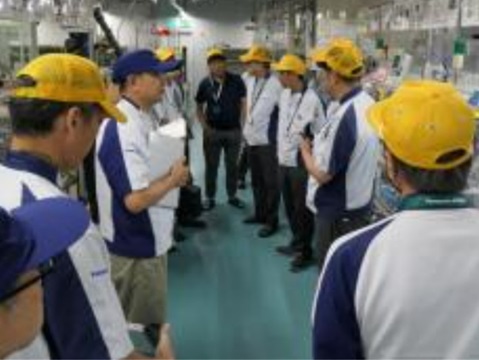
Comprehensive equipment inspection by working group members
Raising employee risk awareness and safety consciousness
We continue to promote cross-site initiatives such as Shin Kakarichokai and Shin Hanchokai, where key frontline leaders learn from each other across sites. These activities aim to eliminate occupational accidents by identifying potential risks and unsafe conditions, improving the ability of employees to recognize hazards, and enhancing on-site improvement skills. We are also promoting the establishment of or upgrades to the Anzen Dojo (experience-based safety practice simulation spaces) at each site, including the use of VR equipment. As a result, each and every employee will be made directly aware of the risks posed by occupational accidents and work to eradicate unsafe behavior.
Furthermore, by thoroughly investigating the causes of occupational accidents and fire incidents within the Company and sharing the results, we promote recurrence-prevention activities at all sites.
With regard to new domestic and global sites associated with future business expansion as well, we are aiming for zero lost time incidents while working to strengthen the foundation for continuous business activities.

Group leaders from each site meet to exchange opinions through on-site confirmation

Utilizing VR equipment at the Anzen Dojo
Preparing for natural disasters
To prepare for major earthquakes such as a Nankai Trough earthquake or a Tokyo inland earthquake, we are advancing seismic reinforcement measures for buildings and other facilities, as well as tsunami countermeasures through the installation of seawalls. In addition to these “hard” physical measures, on the “soft” side, we conduct various disaster-preparedness drills—including headquarters exercises and safety-confirmation drills that simulate emergency situations—and carry out awareness-raising activities aimed at ensuring the safety of employees and their families to encourage them to prepare at home.

Seawall
Integrated Report
The Integrated Report is intended to help our various stakeholders deepen their understanding of our company by disseminating financial and non-financial information, including details of the management strategy, performance and financial status, and environmental, social and governance (ESG) initiatives.


